
“Uncle” Randolph Jefferson
Thomas Jefferson’s Younger Brother
Here’s a link to a recent short article about Randolph Jefferson by historian Joanne Yeck. Professor Bernard Mayo was first to write about Randolph Jefferson in 1942 in the book Thomas Jefferson and His Unknown Brother Randolph. In addition to a short biography, the book includes a compilation of letters exchanged between the two Jefferson Brothers, including the letter of 12 August 1807 where Thomas invited his brother Randolph to visit Monticello exactly 9 months and 9 days before the birth of Eston Hemings.
The Only Brother of Thomas Jefferson
Randolph Jefferson was born at Shadwell in Albemarle County on October 1, 1755, the only surviving brother of Thomas Jefferson. Younger than Thomas by more than twelve years—almost a full generation in colonial Virginia—Randolph came of age in a very different world than his famous brother, and their adult lives diverged sharply.
The early death of their father, Peter Jefferson, shaped both brothers’ paths. As Randolph approached manhood in the early 1770s, Thomas helped guide his education. Randolph spent about a year in Williamsburg, taking courses at the Grammar School of the College of William & Mary, and studying violin with Thomas’s Italian-born teacher, Frances Alberti. His education and experience exceeded that of most Virginians of his day, but he never pursued a public or intellectual life on the scale of his brother.
In 1776, Randolph inherited his father’s Buckingham County plantation, Snowden, near the town of Scottsville, at a prominent feature known at the Horseshoe Bend of the James River, just 20 miles south of Monticello. While Thomas moved onto the national and international stage, Randolph settled into the role of a local squire, living and farming at Snowden from the 1770s until his death in August 1815, just shy of his 60th birthday.
Soldier, Militiaman, and Local Civic Participant
During the American Revolution, Randolph rode with General Thomas Nelson’s Corps of Light Horse, a volunteer cavalry unit, in an effort—ultimately aborted—to support General Washington. When Banastre Tarleton and British forces threatened central Virginia, Randolph again served the patriot cause. After the war, he volunteered for at least eight years in the Buckingham militia. He rode and served with four militiamen who had black slave mistresses, including one man whose mistress was Mary Hemings, one of Sally Hemings’ sisters. He retired with the rank of Captain, a title he used for the rest of his life.
Though he never became a professional politician, Randolph did participate in civic life. He signed the 1777 “Oath of Allegiance in Albemarle” alongside his brother Thomas and their neighbors, and a rare 1788 Buckingham poll list records him voting for Joseph Cabell and Thomas Anderson as delegates to the Virginia General Assembly. He clearly held political views and engaged in local governance, though always on a modest, county scale.
A Planter Who Kept His Patrimony
Unlike many Virginia planters who slid into ruinous debt, Randolph managed, for most of his life, to maintain his patrimony. He was not a “high liver” or extravagant spender. Contemporary accounts indicate that he became extremely distressed later in life when his second wife, Mitchie Pryor, ran up large store debts in his name. Until then, he appears to have been cautious with money.
Randolph’s relationship to enslaved people at Snowden was complex. He owned, worked, and bequeathed enslaved individuals like other planters of his class, but he also showed what contemporaries called an “unusual concern” for his slaves—on more than one occasion selling off some of his best land so he could keep enslaved families with him rather than separating them. When he wrote his will in May 1808, he directed that his land and other property be sold and the proceeds divided among his sons, but he specifically did not want his enslaved people sold away, preferring that they remain with his family.
Personality and Reputation
Randolph’s behavior has often been summarized through a single, vivid memory recorded by Isaac Jefferson Granger, a formerly enslaved man at Monticello, who recalled:
“Old Master’s brother, Mass Randall, was a mighty simple man: used to come out among black people, play the fiddle and dance half the night....”
There are no similar recollections, oral or written, suggesting that Thomas Jefferson exhibited such behavior. This description points to Randolph’s relaxed manner, love of music and dancing, and informal socializing across racial lines.
Randolph was first suspected of fathering Randolph Jefferson by researcher Pearl Graham in 1958, who interviewed descendants of Hemings in the 1940s. She discovered that Randolph was rumored among descendants of former slaves connected to Monticello to have fathered “colored children”.
Thomas Jefferson’s own characterization of his brother, given in a deposition under oath in 1815, is more nuanced. He described Randolph as kind, generous, and open, but also as a man who “did not possess skill for the judicious management of his affairs”, whose “diffidence in his own opinions”, “extreme facility and kindness of temper”, and “easy pliancy to the wishes and urgency of others” made him very susceptible to influence. Randolph was no intellectual, but neither was he merely “simple”. He could assert himself when he felt wronged—at one point successfully suing their cousin John Jefferson for damages—and he managed to keep his estate largely intact for decades.
Marriage, Family, and the 1808 Will
In 1781, at about twenty-five, Randolph married his first cousin Anne “Nancy” Lewis. Together they raised six children (five sons and one daughter) at Snowden, until Nancy passed away and left Randolph a widower (during the period of most of Sally Hemings’s births). This first-cousin marriage tightly entwined the Jefferson paternal and maternal lines, a fact that would later complicate efforts to interpret Randolph Jefferson family DNA.
On May 28, 1808—just six days after Eston Hemings’s birth—Randolph appeared at Monticello and asked Thomas to draft his will. Thomas prepared a rough draft, they revised it together, and Randolph copied it out in his own hand (twice, to correct small errors), had it witnessed, and left it with Thomas for safekeeping.
In that will, Randolph directed that all lands and other property be sold, with the proceeds divided equally among the legitimate sons (excluding his legitimate daughter, who was recently married).
Second Marriage, Financial Decline, and the Disputed Will
After his wife’s Nancy’s death (around 1799), Randolph remained surrounded by children and grandchildren at Snowden and, by 1809, was living a comfortable planter’s life that his brother Thomas longed for but largely sacrificed in order to continue in public service.
Then, in his mid-fifties, Randolph made a decision that reshaped his family and his estate—he married Mitchie Ballow Pryor, a young woman in her early ‘20’s (likely younger than most of Randolph’s own children) from an upstanding “middling” Buckingham family at the Woodlawn plantation. His marriage to this young woman was not unusual among some Virginia planters, but it was rarely welcomed by adult children from prior marriages, who often saw their inheritances threatened. Thomas Jefferson said that his brother Randolph Jefferson always consulted him about important matters—except one —his second marriage to Michie Pryor. Thomas Jefferson did not approve of their marriage, as well as Randolph Jefferson’s five sons and Jefferson’s daughter Martha J Randolph.
Mitchie had a strong personality, was very controlling, and was unafraid to approach Thomas Jefferson directly about her husband’s management of his Snowden estate. Randolph Jefferson himself became extremely distressed with Mitchie Pryor’s heavy spending, and he became responsible for her large bills with local merchants. In his 1815 deposition under oath, Thomas recalled an 1813 visit during which Mitchie asked him to recommend that Randolph consult her on business and allow her to share in directing his affairs—something Thomas declined to do. Over time, Randolph complained to Thomas that large store debts, especially at Scott’s Ferry and in Warren, were accumulated “chiefly by his wife” and that merchants were being fooled by orders forged in a hand that closely imitated his own.
Under Mitchie’s influence, Randolph altered his estate plans, superseding the May 27, 1808 will carefully drafted with his brother Thomas. Thomas Jefferson also said that if Randolph Jefferson had intended to change his original will, he would have asked him to do so. When Randolph later expressed unease over a will “he did not understand”, his son Randolph Jr rode to Monticello to ask Thomas for help. Thomas drafted a short instrument revoking the new will and restoring the old one. He tried to visit his dying brother but when he reached Scott’s Ferry on the James River, he learned of Randolph’s death, so he turned back and instead deposited the revocation with the court hearing the will contest. Randolph’s sons and Thomas Jefferson tried to break the later will that favored Mitchie, but their challenge failed. The combination of multiple sons, a second marriage, and a disputed final testament eventually forced the sale of Snowden out of the Jefferson family, erasing Randolph’s physical presence from the Buckingham landscape.
Death and Legacy
Randolph died in August 1815 at Snowden. No obituary has been found, and his burial site is unknown.
John Randolph Jefferson
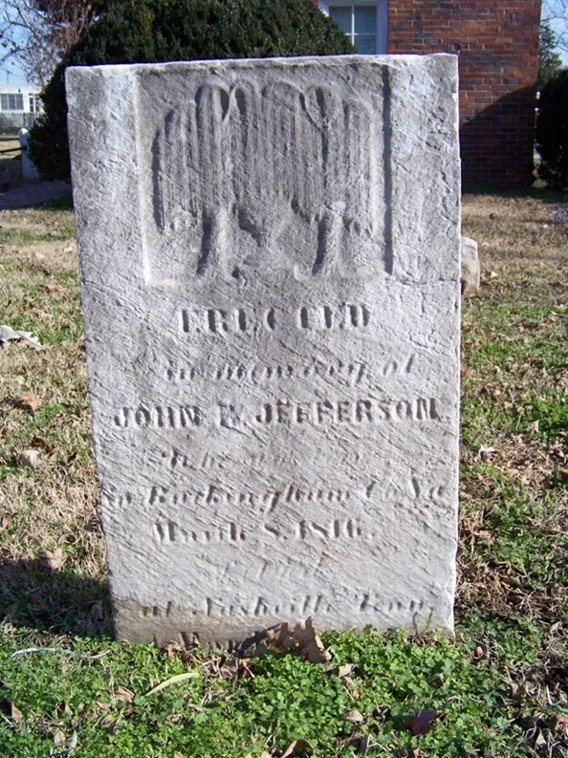
Randolph’s second wife, Mitchie, bore one son seven months after Randolph’s death—John Randolph Jefferson—on about March 8, 1816. She took him to Tennessee to live with her brother Nicholas B Pryor. Since John Randolph Jefferson moved away from Snowden, Virginia to Nashville, Tennessee, it does not appear that John Randolph Jefferson had any contact whatsoever with any of the children of his father’s first wife, his half step siblings. John Randolph Jefferson did marry Amanda McNairy Gilman in 1841, but he died childless on March 9, 1845, about 29 years old, in Nashville, Tennessee, where he is buried in the city cemetery. His death without any heirs also extinguished his last legitimate male line.
His grave in Section 18, Lot 12 of the Nashville City Cemetery is the single surviving biological link to Randolph Jefferson.
Nashville City Cemetery lot record / map excerpt for Section 18, Lot 12, ID # 180031
Had it not been for his famous brother Thomas Jefferson and the later controversies surrounding the Hemings paternity issue, Randolph Jefferson might well have faded into complete obscurity. He lacked Thomas’ intellectual ambition and political reach, and his realm remained local—Snowden, the militia, county politics, family alliances, and the lives—white and Black—that intersected there. Yet in that smaller world, he appears to have been, by most accounts, fundamentally content—a Virginia captain and planter who accepted his lot in life with a mixture of cheerfulness, vulnerability, and stubborn attachment to his family, his land, and the enslaved people he refused to sell away.
Historians have claimed that up until the results of the 1998 DNA study were released, Randolph Jefferson was never considered to be a paternity suspect of Sally Hemings' children, so why consider him now?
Actually, descendants of Eston Hemings had long passed down the oral history that their paternal ancestor was an “Uncle” Jefferson. At Monticello, “Uncle” was Randolph’s nickname. Julia Westerinen, a descendant of Eston Hemings, told the Washington Post that prior to 1976, “We were told we were related somehow to an uncle of Jefferson’s.” However, after controversial author Fawn Brodie met with her and insisted differently, Westerinen abruptly changed her belief about her own family’s oral history to embrace the belief that she was descended from Thomas Jefferson and Sally Hemings:
I was told we were related to Jefferson’s uncle; that’s what was handed down in the family. I don’t know who started that lie.... It was 1975, after Fawn Brodie’s Thomas Jefferson: An Intimate History came out. My aunt recognized Eston’s name from our family tree and she called the author. Fawn did the research, came east and interviewed us, and said, “You’re directly descended from Thomas Jefferson, but through this woman named Sally Hemings, who was his slave.” So that’s when we first found out about it. (Scholars Commission p.162)
It has been claimed that Thomas Jefferson was present at Monticello during all the conception periods for all of Sally Hemings' children, making him the only suspect.
For an in-depth analysis by statistician David Murray, PhD, former Director, Statistical Assessment Service, see Present at the Conception (The Jefferson-Hemings Myth - An American Tragedy, p 117). Also see Jefferson Vindicated – Fallacies, Omissions, and Contradictions in the Hemings Genealogical Search by Cynthia H Burton on the topic of Thomas Jefferson’s Arrivals at Monticello vs. Conception Periods (p 37-40).
Jefferson made 22 visits to Monticello during the relevant conception years, yet no conceptions occurred during 17 of those visits. When suggesting an ongoing relationship, is important to note that Jefferson did not bring Sally Hemings with other slaves to Washington DC where he spent 8 years as President 1801-1809. After his presidency, Jefferson returned to Monticello in 1809 and Sally Hemings stopped having children.
When Thomas Jefferson was not at Monticello, his residence was largely closed. When he was in residence, the house was frequently filled with guests (sometimes up to fifty), offering almost no privacy. Thomas Jefferson’s daughter Martha, her children, and others slept in adjoining spaces, making secret liaisons difficult to imagine or discover. Property Overseer Edmund Bacon also had unrestricted access to Jefferson’s room—even at night—further contradicting any notion of a secret liaison.
Critically, the conclusion that Thomas Jefferson fathered Eston Hemings assumes no other Jefferson males could have been present during his conception window. This overlooks the simple fact that Jefferson’s male relatives—who shared the same Y-chromosome—were far more likely to visit Monticello when Jefferson was home. Unfortunately, historians have rarely examined these other Jefferson males as credible suspects. In a significant omission, Annette Gordon-Reed’s famous book Thomas Jefferson and Sally Hemings, An American Controversy —a book that claimed to argue all possibilities for paternity — failed to explore let alone even mention Randolph Jefferson as a suspect. In short, Jefferson’s presence on projected conception dates neither proves he was the father nor rules out other Jefferson males.
What is more likely, and a simpler explanation, is that Jefferson’s male relatives would visit Monticello and have much more freedom to “sneak off”, while all attention and responsibility was on Thomas Jefferson as he entertained guests as host. Among others, a highly likely candidate for such behavior was Jefferson’s brother Randolph Jefferson, who was 12-years younger, lived a mere 20 miles south, and carried the same y-DNA as his brother Thomas.
One of the only eye-witness accounts of Sally Hemings’ paramour comes from Captain Edmund Bacon, the property overseer at Monticello when Eston was conceived. In his retirement he dictated his memoirs in interviews with the Reverend Hamilton Pierson. Bacon described how he saw not Thomas Jefferson but another man coming out of Sally Hemings’ cabin on many mornings:
“[Thomas Jefferson] freed one girl some years before he died, and there was a great deal of talk about it. She was nearly as white as anybody and very beautiful. People said he freed her because she was his own daughter. She was not his daughter; she was _____’s daughter. I know that. I have seen him come out of her mother’s room many a morning when I went up to Monticello very early.”
Rev. Pierson he said he omitted certain names “in regard to the intemperance, and other vices… of some who were connected with Mr. Jefferson’s family.”
While an affair between Randolph Jefferson (or his sons) and Sally Hemings may not appear as scandalous and tantalizing as an affair with Thomas Jefferson, the other Jefferson male relatives must be considered as paternity suspects in an unbiased search for the truth.
The Jefferson-Hemings Controversy - The Report of the Scholars Commission—an independent blue-ribbon panel convened by the Thomas Jefferson Heritage Society—brought together 13 distinguished historians, legal scholars, and DNA experts from 12 major universities. Their year-long investigation produced a 550-page report that systematically re-examined every piece of evidence: the 1998 DNA study, Monticello plantation records, contemporaneous family testimony, population-level paternity probabilities, and the political context of the original 1802 Callender paternity accusation.
The Scholars Commission’s findings were strikingly different from the headlines of the era. Twelve of the thirteen scholars concluded that the case for Thomas Jefferson’s paternity was “by no means proven”, with most assessing the likelihood as weak to highly unlikely. Several members found stronger historical footing for Randolph Jefferson or other Jefferson-male relatives as candidates—an aspect the 1998 DNA study did not explore.
Crucially, the Scholars Commission emphasized that Y-chromosome DNA alone cannot distinguish among Jefferson men, and that the historical record contains gaps, contradictions, and politicized testimony that prevent definitive conclusions. Their report, though widely cited in academic circles, received little mainstream media attention, leaving many Americans unaware that such a comprehensive review ever took place.